

The Itraconazole Mystery: Gnosis points to SMO
A widely used antifungal with unexpected anticancer activity and more than fifteen years of mechanistic debate. In a structural comparison against SMO and VDAC1, Vecentra favours SMO as the clearer predicted interaction, and turns a long question into a focused next experiment.
Itraconazole was developed to fight fungal infections. Its activity against cancer-related biology opened a larger question: which molecular interactions actually drive its effects? Since its Hedgehog-inhibiting activity was reported in 2010, the picture has stayed complicated, spanning Smoothened (SMO), mitochondrial metabolism and cholesterol trafficking. For a development team, knowing which interaction matters can shape a molecule’s future.
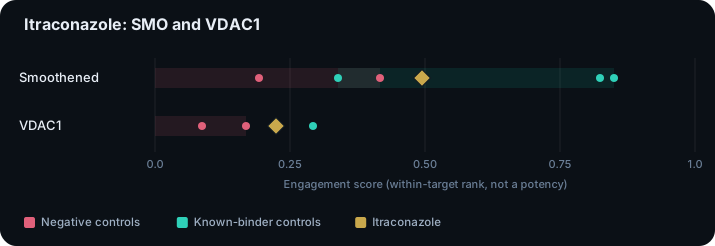
Our analysis puts SMO at the centre of the next experimental decision. In a structural comparison against SMO and voltage-dependent anion channel 1 (VDAC1), itraconazole scored above both SMO negative controls and within the known-binder range, while its VDAC1 result stayed intermediate. The comparison therefore favoured SMO as the clearer predicted interaction, and a second model added a complementary read: a predicted cholesterol-related cellular response. This note shows how the platform turns molecular structure into a prioritised mechanistic investigation. Itraconazole is the central example; rigosertib is a complementary case where the structural and cellular-response outputs converge on the same alternative target.
Compare the targets, inspect the controls
For each target we score known binders and deliberately chosen negative controls before interpreting the compound of interest. That makes the quality of each comparison visible: clear separation supports a reading, while overlap or a thin reference panel lowers confidence. Two complementary components contribute. Gnosis I evaluates candidate protein interactions from structure. Gnosis IV predicts a compound’s transcriptional response in a given cell and derives mechanism-class and pathway outputs from it. The target scores rank compounds within each target’s own panel; they are not binding affinities and do not license a potency comparison between proteins. Gnosis IV outputs are predictions, not measured expression.
Case one: recovering an alternative mechanism for rigosertib
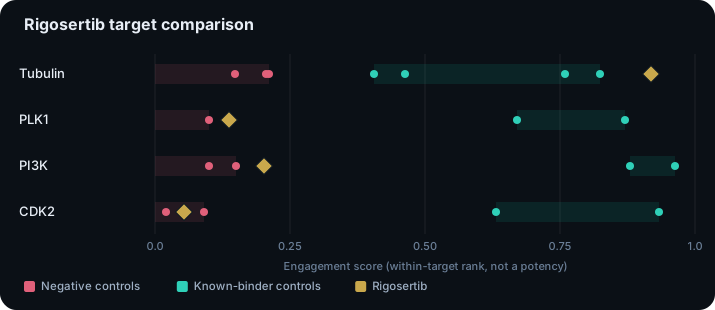
Rigosertib has been investigated with several proposed mechanisms, including PLK1 inhibition, effects on RAS signalling, and microtubule destabilisation. That disputed history makes it a good test of whether the platform can recover a mechanistically relevant alternative. In our PLK1 comparison it scored well below the known PLK1 binders. Gnosis IV added a clue: its predicted cellular response most resembled microtubule-targeting compounds, though the molecule was flagged as outside the model’s usual chemical domain, so this was exploratory.
We tested the tubulin hypothesis with Gnosis I, using four known tubulin binders and three negative controls, two of them PLK1 inhibitors. The reference groups separated cleanly, and rigosertib scored above the known binders, including colchicine and podophyllotoxin. We then compared four candidate targets, tubulin, PLK1, PI3K and CDK2: tubulin was the only one for which rigosertib reached or exceeded the known-binder group. The analysis covers the proteins and sites evaluated here and does not exclude other targets or binding modes. A tubulin mechanism has support in the literature and has also been contested, so this is a computational recovery of that hypothesis, not a claim about why rigosertib failed in trials.
Case two: disentangling itraconazole’s mechanisms
Itraconazole is harder, because it has several biological activities with potentially different molecular drivers, from suppression of endothelial proliferation and angiogenesis to inhibition of Hedgehog signalling. A useful analysis has to keep the evidence for each activity separate and allow more than one mechanism to contribute.
VDAC1, in the outer mitochondrial membrane, is an experimentally supported itraconazole target in endothelial cells: inhibition shifts mitochondrial metabolism, raises the AMP to ATP ratio and activates AMPK, which suppresses mTOR signalling. A second supported target, the lysosomal cholesterol transporter NPC1, acts by disrupting cholesterol trafficking. SMO addresses a different part of the pharmacology: the original Hedgehog study showed inhibition at the level of SMO, including reduced ciliary accumulation, while distinguishing it from blockade of sterol biosynthesis. Whether that reflects a direct physical interaction is a separate question, and the one we examined.
- VDAC1: mitochondrial metabolism, AMPK activation and mTOR suppression in endothelial cells. Scored here, but unresolved with the limited reference panel.
- SMO: Hedgehog pathway inhibition; a direct binding interaction is the hypothesis evaluated here, and the reference groups overlap.
- NPC1: lysosomal cholesterol trafficking and mTOR regulation. Relevant biological context, not scored in this comparison.
We compared itraconazole against SMO and VDAC1 using separate reference panels, and included a related antifungal among the SMO negative controls to challenge discrimination within the same drug class. For SMO, itraconazole scored above both negative controls and above cyclopamine, while staying below the two clinical SMO inhibitors; one negative control also scored above cyclopamine, so the groups overlap and we show that limitation. For VDAC1, it landed between the negative controls and the single known binder, leaving its classification unresolved in this panel. The structural comparison therefore favoured SMO over VDAC1 as the clearer predicted interaction.
A complementary view from the cell
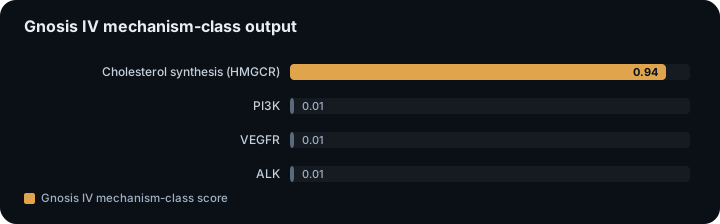
We then used Gnosis IV to predict itraconazole’s transcriptional response in A549 lung and PANC-1 pancreatic cells. Itraconazole fell within the model’s reported applicability domain. In both cell lines the classifier assigned 0.94 to the cholesterol-synthesis class labelled HMGCR, with competing classes such as PI3K, VEGFR and ALK near 0.01. This is a class assignment, not proof that itraconazole binds HMGCR, and cholesterol synthesis, cholesterol trafficking and direct HMGCR inhibition are different mechanisms. The prediction is relevant to itraconazole’s known cholesterol-related pharmacology and motivates comparison with measured signatures and target-specific controls.
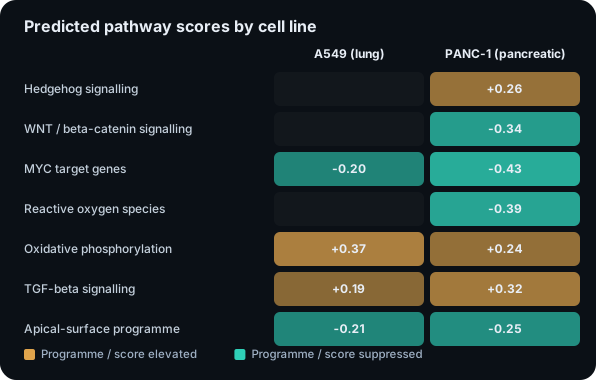
The predicted pathway profiles differed by cell line. Hedgehog signalling appeared among the PANC-1 outputs with a positive score of plus 0.26 but was not among the displayed A549 outputs. This is a context-dependent prediction to investigate, not a demonstration of Hedgehog inhibition, and its absence from the A549 display is not evidence of no effect. PANC-1 can also regulate GLI1 through SMO-independent routes, which matters when choosing a functional model.
Because these are predicted expression changes, the individual gene rankings are the least-validated layer of the output, and we do not show them. Gnosis IV is validated at the mechanism-class and pathway level, which is the resolution reported above. Gene-level predictions are available on request as hypothesis-generating leads for comparison against measured signatures, not as evidence of a specific causal target.
What a partner can act on
The case links a structural SMO hypothesis, an unresolved VDAC1 comparison and a predicted cholesterol-related response in one analysis, and it makes the next decisions explicit: test SMO engagement directly, strengthen the VDAC1 comparison, include NPC1, and determine which interactions drive the cellular phenotype. A natural follow-on is to predict chemical changes that separate Hedgehog effects from endothelial effects, with published analogue series as a demanding retrospective benchmark, subject to checking training overlap. These are proposed next steps, not results demonstrated here.
- Target prioritisation: the scores identify candidate interactions within the evaluated panel, with the quality of each reference comparison made explicit.
- Experimental direction: binding hypotheses and predicted cellular responses help define follow-up assays, appropriate models and informative controls.
- Prospective validation: broader performance requires an independently chosen compound set, training-overlap checks and predefined success criteria.
A candidate mechanism becomes useful when it leads to a decision: what to test, where to test it, and what result would change the programme.
Vecentra Research
A companion note, "Would it have worked?", takes the opposite question: when a drug does engage its target, what then decides whether it helps a patient.
Sources
- Kim et al. (2010). Itraconazole, a commonly used antifungal that inhibits Hedgehog pathway activity and cancer growth. PubMed 20385363.
- Head et al. (2015). Antifungal drug itraconazole targets VDAC1 to modulate the AMPK/mTOR signaling axis in endothelial cells. PubMed 26655341.
- Head et al. (2017). Simultaneous targeting of NPC1 and VDAC1 by itraconazole leads to synergistic inhibition of mTOR signaling and angiogenesis. PubMed 28103683.
- Itraconazole side-chain analogues (2011): structure-activity relationships for endothelial proliferation, VEGFR2 glycosylation and Hedgehog signalling. PubMed 21936514.
- Jost et al. (2017). Chemical-genetic screens identify rigosertib as a microtubule-destabilizing agent. Molecular Cell. PubMed 28919077; and the contested follow-up, Baker et al., 2020. PubMed 32619468.
- Triazoles bind the C-terminal domain of SMO (2019): docking and molecular dynamics study. PubMed 30543826.
Structural comparisons were produced by Gnosis I and cellular-response predictions by Gnosis IV. Targets, reference compounds and clinical context are drawn from the public literature and public structural data, and compound names are used for identification only. This is a retrospective analysis, not medical advice, and no Vecentra pipeline compounds or implementation details are disclosed.
Vecentra outputs are intended for research use only and are not validated for clinical diagnosis or therapeutic decision-making.