

Would it have worked? Testing our models against the drugs that failed
Potency does not separate the oncology drugs that reached patients from the ones that failed. Across 22 compounds and 8 cancer targets, target engagement and cohort biology do. A retrospective research note, with the limits stated plainly.
You can design a molecule, synthesise it, and show potency in a dish. Whether it will help a real patient, in a disease where no two tumours are alike, is a different question. We put our models to that question against oncology trials whose outcomes are already on the record, and the first result reframed the study: we expected potency to be the deciding signal, and it was not.
We assembled 22 oncology compounds across 8 well-characterised cancer targets. Some are approved drugs in current use; others reached late-stage trials and failed. We asked our bioactivity model, Gnosis I, a single question: from chemistry alone, can it separate the successes from the failures by predicted cell-killing potency?
Ranked that way, the two groups were not separable. Failed drugs scored as well as approved ones, and several approved medicines scored low, because their benefit depends on the biology of a specific tumour that a short viability assay does not capture. This is not a defect in the model. It is the shape of the problem, and much of the field meets it: a compound can be potent and still fail, because the reasons drugs fail in the clinic usually sit downstream of the chemistry. So we stopped asking whether a molecule is potent and asked the question with a testable chemical answer: does it engage the target it is claimed to engage?
Target engagement: the question with a testable answer
Before a drug can act through a target, it has to bind it. That is chemistry, and it is what a co-folding step inside Gnosis I is built to answer. It does not read a label; it places the molecule against the protein and scores how well it is held. For every target, the genuine approved binders ranked at the top, and three of the most prominent efficacy failures in oncology fell to the bottom of their own target, exactly where the later science places them.
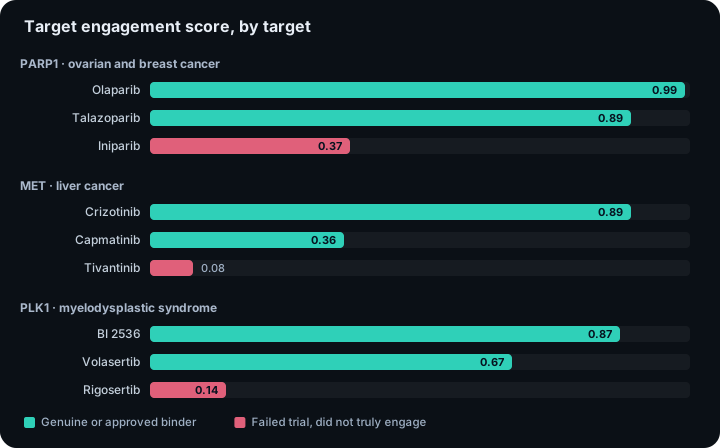
- Iniparib was presented as a PARP inhibitor and taken into a large triple-negative breast cancer trial, which it did not pass. Later chemistry showed it does not inhibit PARP the way the approved drugs do. Gnosis I scores it 0.37 for PARP1, well below olaparib at 0.99 and talazoparib at 0.89.
- Tivantinib was developed as a MET inhibitor for liver cancer and failed its Phase 3 study. Later work found much of its cytotoxicity is unrelated to MET and traced it to tubulin binding at the colchicine site. Gnosis I scores it 0.08 for MET, against crizotinib at 0.89.
- Rigosertib advanced to Phase 3 for myelodysplastic syndrome on the claim that it blocks PLK1 and the RAS pathway. The trials failed and its mechanism has been debated for a decade. Gnosis I scores it 0.14 for PLK1, against a genuine PLK1 binder at 0.87.
None of these were handed to the model as a list. It read the chemistry and reached the same conclusion as the clinic and the follow-up literature, from the molecule alone. Across every head-to-head pair in this retrospective set, Gnosis I placed the real binder above the non-engager in 96 percent of comparisons.
One control mattered to us. Any model can look capable on old, heavily studied molecules. So we included capivasertib, an AKT inhibitor approved only in late 2023, outside the set of textbook compounds. Gnosis I identified it as a genuine binder at 0.74, which suggests the engine is reading chemistry rather than recalling a memorised list.
When the molecule is sound and the cohort is not
Cancer is not one disease. The same drug can succeed in one patient and do nothing, or harm, in another, and the deciding factor is often a single feature of the tumour. No potency score flags this, because the chemistry is genuinely adequate. Three established cases make the point, and in all three Gnosis I confirms the drug does engage its target.
- Gefitinib engages EGFR. It failed in a large unselected lung cancer trial, then succeeded once trials enrolled patients whose tumours carried an activating EGFR mutation.
- Vemurafenib engages BRAF. It is approved and effective in melanoma driven by the BRAF V600E mutation; in tumours without it, it can paradoxically activate the pathway and accelerate growth.
- Selumetinib engages MEK. It failed several trials in broad patient groups, then was approved for children with NF1-related plexiform neurofibromas.
What changed between failure and approval was not the molecule but the patient group. That is why our platform treats the question of which patients as a first-class problem, alongside which molecule.
An independent read, from the cell
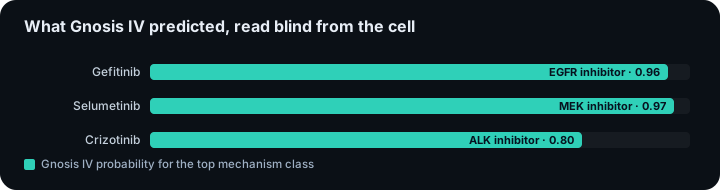
Target binding is one view. A second is to ask what the cell does once the drug arrives. Our mechanism model, Gnosis IV, predicts the gene-expression response a compound induces and infers the mechanism from it. We ran it on every drug in the study, blind to the stated target.
Where it is confident, it names the real target. For gefitinib the top mechanism class was EGFR inhibition at 0.96, for selumetinib MEK inhibition at 0.97, and for crizotinib ALK inhibition at 0.80, each read only from the predicted cellular response. Gnosis IV is validated at this mechanism-class resolution; its raw per-gene rankings sit below that bar and are not reported here.
Where it is uncertain, it abstains. The failed molecules with unusual chemistry are flagged as outside the training distribution, and the model declines to name a mechanism rather than guess. That restraint is deliberate: when pushed to label a drug it had flagged as unfamiliar, it returned the wrong answer, which is the reason the guard exists. One signal was still worth noting. Even while flagged as uncertain, rigosertib’s predicted response most resembled microtubule-targeting drugs, a mechanism distinct from the one it was built on and consistent with what chemists reported independently years later. We record it as a signal, not a finding.
Beyond the target: the biology that defines the cohort
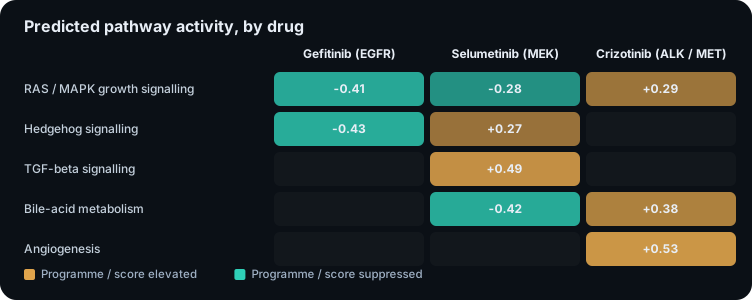
Gnosis IV goes further than a target name and scores which biological programmes the cell turns up or down. For the two drugs whose outcomes were decided by patient selection, gefitinib and selumetinib, it moved the RAS and MAPK growth-signalling axis in the same direction, the exact biology their responder groups are built on. Crizotinib, approved against both MET and ALK, read as ALK from its cellular response, matching the rearrangements that actually define its responders rather than MET. We treat these pathway reads as direction, not calibrated magnitude.
Reading the cohort from the cell itself
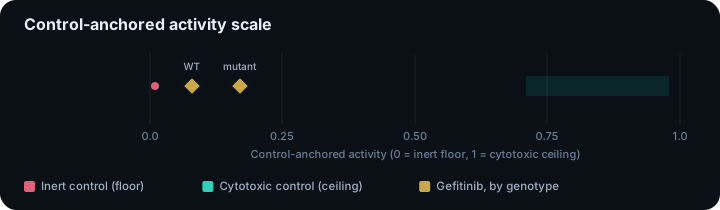
There is a harder version of the cohort question: setting aside what we know about the patient, can a model read a tumour cell’s own genetics and say whether a drug will hit it harder? This is the task of Gnosis II. Rather than trust a single noisy potency value, we ran two controls in every cell line, a broadly cytotoxic compound to set the ceiling and an inert compound to set the floor, and measured where the drug fell between them. Gefitinib read about twice as active in EGFR-mutant cells, at 0.17, as in wild-type cells, at 0.08: the right direction, but a modest signal that leaned on a single cell line and did not reproduce for the BRAF drugs. A cell-killing score can rank and hint; it is not sharp enough to select a patient population on its own, especially when one mutation makes the call.
One drug, two patients, two verdicts
Here the pieces combine. For any drug and tumour genotype we run a single panel that asks three independent questions and never averages them into one score: does it kill these cancer cells while sparing normal ones, which programmes does it move, and does this tumour carry an activating change in the drug’s own target. Run across four tumours, gefitinib receives opposite verdicts, with the only variable being the patient’s genetics.
- HCC827, EGFR mutant with an E746 to A750 deletion: genotype-selective vulnerability.
- NCIH1975, EGFR mutant with L858R and T790M: genotype-selective vulnerability.
- A549, EGFR wild type: no actionable alteration.
That genotype call is carried by the biomarker read, the clinically validated one, not by the cell-killing score, which on its own did not separate these patients. The platform always says which engine holds a claim, and reports disagreement rather than hiding it in an average.
Honest scope
- This is a retrospective illustration of how the models reason, not a validation study, and it yields no error bars.
- Confirming that a drug engages its target is a real, inexpensive early result; clinical benefit is a separate question that depends on the cohort.
- Every score here is a ranking within a target and a prediction, not an absolute potency, a clinical therapeutic index, or evidence of function in a patient.
- Some failures sit beyond any molecule-level model, in the biology and the patient group. That is the half our mechanism, cohort and safety models are built to address.
A drug does not succeed or fail in general. It succeeds or fails in a cohort, and naming that cohort in advance is half the work.
Vecentra Research
A companion note follows two of these failures further. If a molecule does not engage the target it was named for, what does it engage? "The Itraconazole Mystery" reports how the platform rejected one drug’s stated mechanism and supplied missing evidence for another drug’s long-disputed one, from structure alone.
Sources
- Iniparib nonselectively modifies cysteine-containing proteins in tumor cells and is not a bona fide PARP inhibitor. Clinical Cancer Research, 2012. PubMed 22128301.
- Basilico et al. Tivantinib (ARQ197) displays cytotoxic activity that is independent of its ability to bind MET. Clinical Cancer Research, 2013. PubMed 23532890. Colchicine-site tubulin binding: Molecular Cancer Therapeutics, 2014.
- Jost et al. Combined CRISPRi/a-based chemical genetic screens reveal that rigosertib is a microtubule-destabilizing agent. Molecular Cell, 2017. PubMed 28919077. A contested follow-up attributing the effect to a degradation product: Baker et al., 2020. PubMed 32619468.
- Mok et al. Gefitinib or carboplatin-paclitaxel in pulmonary adenocarcinoma (IPASS). New England Journal of Medicine, 2009.
- Poulikakos et al. RAF inhibitors transactivate RAF dimers and ERK signalling in cells with wild-type BRAF. Nature, 2010; and Hatzivassiliou et al. Nature, 2010.
- Gross et al. Selumetinib in children with inoperable plexiform neurofibromas (SPRINT). New England Journal of Medicine, 2020.
- Turner et al. Capivasertib in hormone receptor-positive advanced breast cancer (CAPItello-291). New England Journal of Medicine, 2023.
Target engagement was scored by Gnosis I and predicted mechanism by Gnosis IV, with cohort context from Gnosis II. Compound outcomes are drawn from the public clinical and scientific record, and compound names are used for identification only. This is a retrospective analysis, not medical advice, and no Vecentra pipeline compounds or implementation details are disclosed.
Vecentra outputs are intended for research use only and are not validated for clinical diagnosis or therapeutic decision-making.